THE COST OF AUTOPILOT
Your structure is already making your year-end decisions. You have until Christmas to take back control of your results.
Fifteen weeks
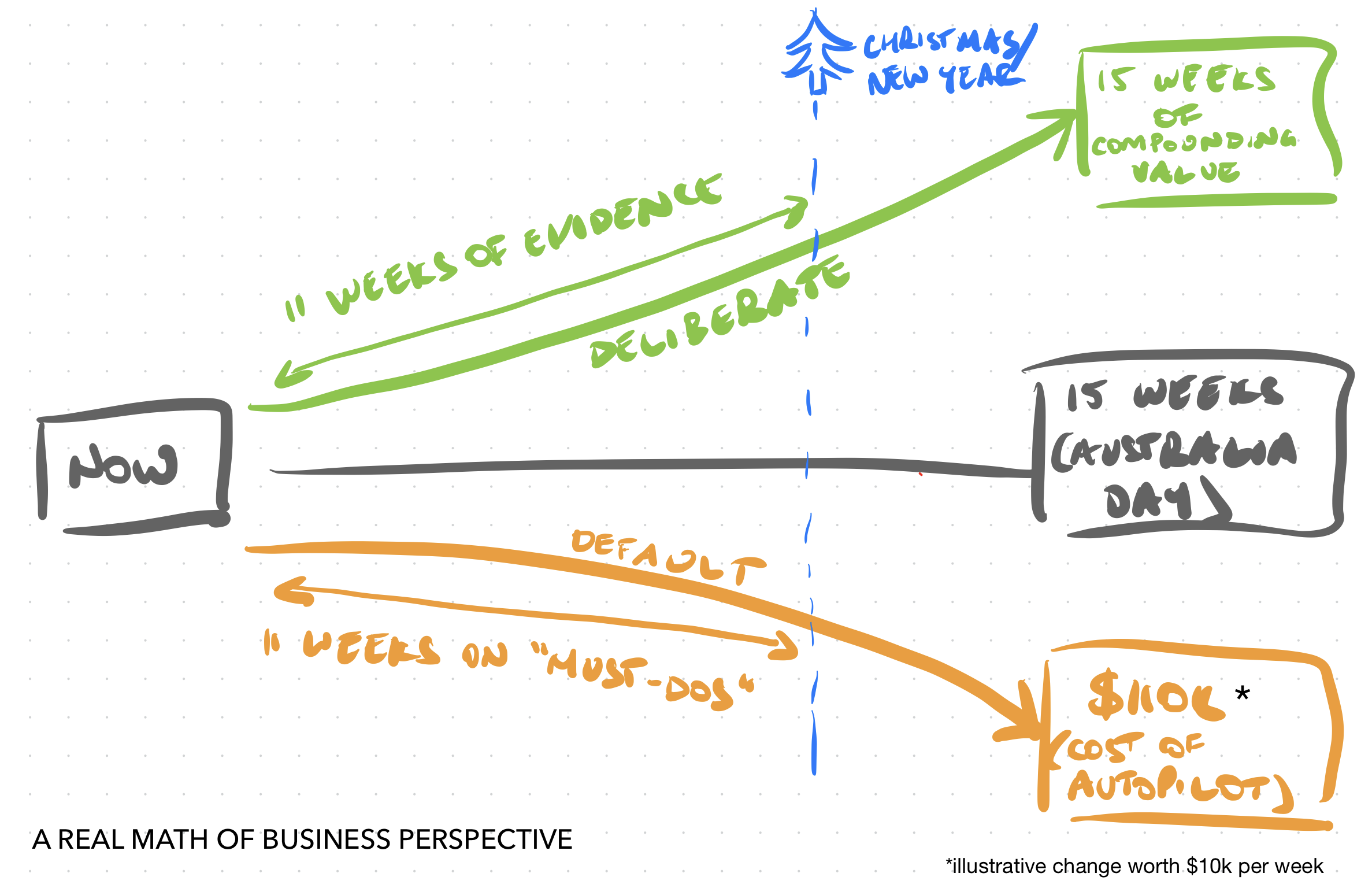
It's mid-October. Christmas is about ten weeks away and Australia Day is fifteen.
Most businesses will get through those weeks on autopilot. Two things will happen. Between now and Christmas, businesses will focus on the "must-dos" and park everything else, a natural response to the unspoken countdown that starts this time of year. Over the break, whatever is running will keep running because the people who can change it are away. No one decides this. It just happens because that's what the default structure of your business does when nobody steps in.
That is what autopilot costs: fifteen weeks of learning that never happens, and results that never start to compound, because the business is waiting for the new year to begin. Say any one change is worth $10,000 upside a week. Start it in January instead of now and you've given up about eleven weeks, or $110,000, before you've learned a single thing. And that's best case, because decisions that need other people can't progress until they're back from leave.
Why the default wins
In my experience, the weeks before Christmas narrow fast. Everyone puts their head down, gets those "must-dos" done and leaves everything else until the new year, usually with a promise that January is when they'll catch up and start the new things.
What rarely gets asked is whether the must-dos are the most important ones. Often the business-as-usual items are finished first, and the strategic ones with the most impact wait. Each function has its own "must-do" list, and anything that needs a cross-functional decision is hardest to organise when time is tight and people are taking leave at different times.
"The urgent are not important, and the important are never urgent."
Dwight D. Eisenhower, 1954 (quoting a former college president)
Researchers Meng Zhu, Yang Yang and Christopher Hsee call this the mere urgency effect. In five experiments, people often chose an urgent but unimportant task over a more important one, and the effect was stronger in people who saw themselves as busy. It weakened when they were reminded of the payoffs at the moment of choice. That reminder is exactly what most year-end routines leave out.
The Christmas break doesn't fix this. Nearly all the CEOs and CFOs I work with look forward to January as the time to catch up on their work and their thinking, because no one is around. The same quiet means the decisions that need other people can't progress either.
None of this is a character flaw. Each behaviour points to how the business is built. The Real Math of Business methodology reads a business through six levers of math: market, strategy, people, company, acquisition and control. Four of them show up here. Heads-down delivery of the "must-dos" is symptomatic of the control math and people math running in your business: what gets tracked is delivery, and people are accountable for their own function's list. Cross-functional decisions, which are often the strategic, higher-impact ones, stall because of company math: the work is organised by function and nothing builds in time for the links between them. And the missing priority check is a gap in strategy math: nothing in the year-end routine makes anyone rank the work by its impact.
This is the complexity tax. As a business gets more complex, its structure slows the path from information to decision to evidence, and the business pays for that delay whether or not anyone chose it.
Start training today
I love the concept of a temporal landmark. I first heard about this concept from Daniel Pink in his book, "When: The Scientific Secrets of Perfect Timing". It's basically an intangible time or date that allows you to draw a line in the sand and say, 'tomorrow things will be different'. A new year's resolution is the classic example. Dai, Milkman and Riis named the pattern the fresh start effect: they found that diet searches, gym visits and commitments to goals all rise after landmarks such as a new year, a new month or a birthday.
You've probably heard someone say they'll start their training from 1 January. It sounds sensible. December is busy, January feels like a fresh start, and a few weeks now wouldn't count for much anyway. A landmark is useful for motivation, but it also makes waiting feel reasonable, and what you give up while you wait is evidence.
Someone who starts today gets fifteen weeks of results, but more importantly, has fifteen weeks of data and feedback by Australia Day. They find out which sessions they'll actually turn up for, how their body responds and what needs changing, and each week builds on the one before. The first signs show up in sleep, energy and what they can lift, long before the result they're after. Someone who starts on 1 January has the same goal and the same ability, with eleven weeks less to go on. They spend January hoping - without evidence - that the results will come.
Businesses do the same thing with decisions that could start now. Compounding starts with the first decision you act on, and that can be today.
Where does your business lose time?
You probably have a sense already that this period of time isn't being used most effectively. The harder part is knowing what's not working, where in the process it's broken down and what can be done about it.
We use The Real Math Loop™ (The Loop). The six levers of math show you what to look at. The Loop shows you how quickly your business moves through them.
Every piece of information that may form a decision passes through five stages, and time can go missing at any of them. That missing time is how the complexity tax shows up in your business.
SEE → SENSE-MAKE → DECIDE → ACT → LEARN
• SEE: When something changes, how soon does it become visible to you? Is it on your radar as it happens, or in a report weeks later?
• SENSE-MAKE: Can you tell what it means across the whole business, or does the picture stay inside one function? How efficiently and effectively are the dots connected?
• DECIDE: How long until someone says continue, adjust or stop?
• ACT: Once it's decided, how long before anyone's behaviour changes?
• LEARN: When do you find out whether it worked, and does that go back into the next SEE? Waiting for the final financial result is the slowest way to find out, and leading indicators get you the answer sooner.
An invitation to act (and learn)
Start by looking back. Pick one recent decision whose results you can now see and trace it through the five stages. How long did each stage take, and what was the lag between them? Some of that delay will have been valuable (resulted in improved judgement) and some will only have slowed you down. Find the stage where the time bleeds.
Then look forward. Choose one decision that's currently parked until January, and run it through The Loop this week in its smallest form. What do you already know? What's the smallest version you could decide on and start before Christmas, without relying on people who'll be away?
Then determine what you'll look for to know it's working, who will look, and when. Note how many days it takes to get from today to your first piece of evidence.
Wherever it stalls is where your structure is costing you.
What will you have compounding by Australia Day?
Two questions to settle before Christmas.
• What will you start now, so you have evidence by the new year?
• What do you want compounding between now and Australia Day?
Alena Bennett
Founder and CEO, Real Math of Business Institute
The Real Math of Business explores how organisations create, convert and sustain value as they grow and become more complex.

Author: Alena Bennett
Alena works with leaders and their teams to connect technical and leadership skills so they can deliver to deadline without killing their people.

This is the trusted guide for CFOs to lead with IMPACT and create VALUE.
It's time for women in finance to find power in their purpose!