The most strategic thing a CFO can do in the last three months of the year
I can't believe it's October already, and like you, every CFO is very aware that December is a short month.
CFOs like you are trusted by your CEO, have good relationships with your peers, and have become fluent in financial storytelling for your business. That's your life's work. To date.
Most of that work, however, happens 'in' the business: responding to requests, analysing and supporting decisions under debate, keeping the engine going. The thing that makes Playmaker CFOs stand out is that they focus their attention and energy 'on' the business.
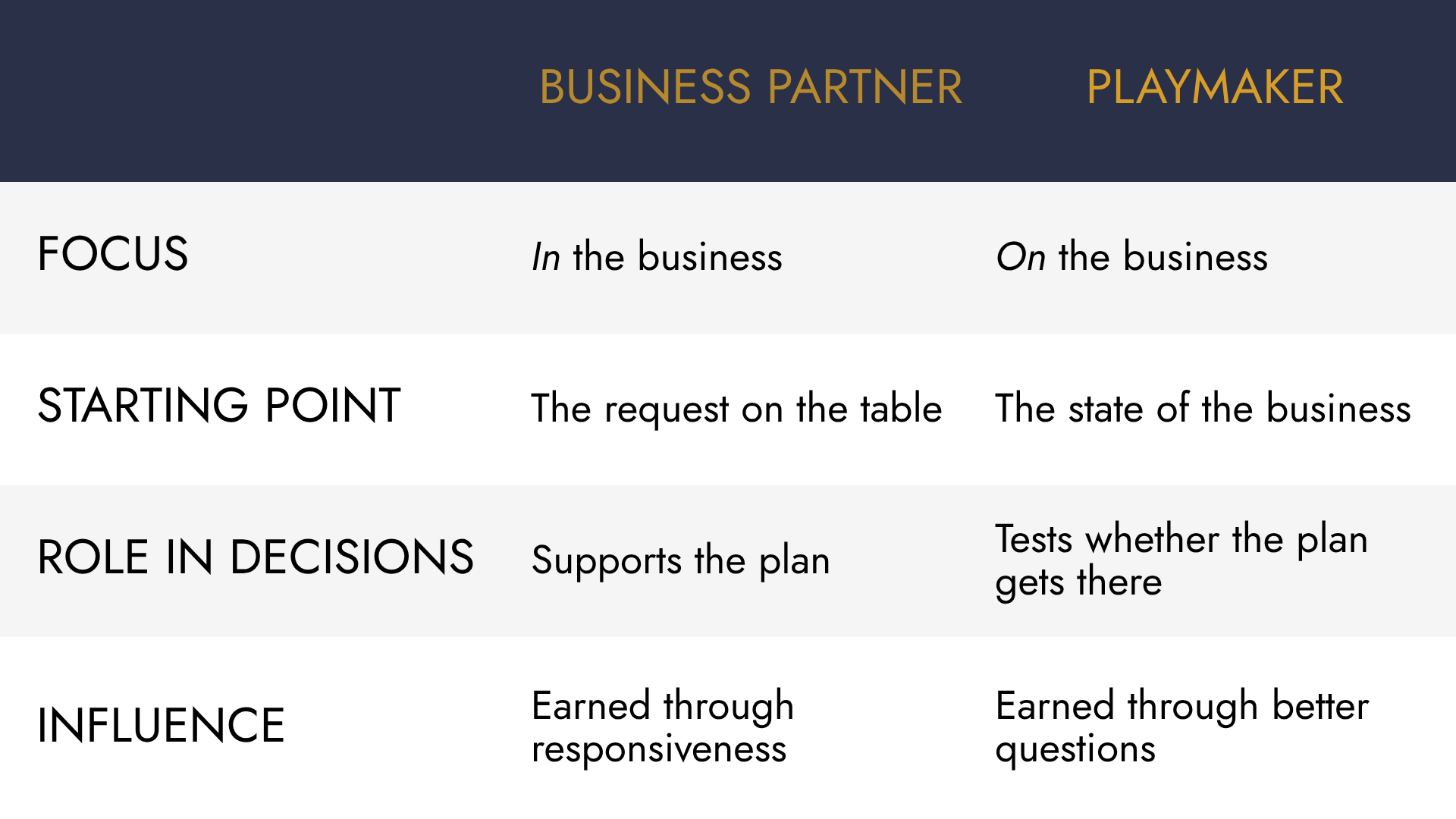
As the trusted business partner, you'd be forgiven for focusing on questions like 'how do I tell the story of these numbers more effectively so that I can have more influence in making the right decisions?' Great question.
What makes a Playmaker different, however, isn't that they're smarter or harder-working. They just ask different questions.
At this time of year, these are the 5 key questions they're asking.
Question 1: "How close are you to your growth goal today?"
Playmakers go for precision. They don't accept 'we're a bit behind' or 'we're on track'. They get a number: '$X is the gap', or 'We're tracking 85% to budget'.
Question 2: If your people executed your strategy perfectly from Monday, would you hit your number?
This question goes to the heart of the Real Math of Business™ (RMOB) methodology. Leaders often don't ask this question because it sounds like it challenges 2 key things: the strategy (and the CEO by extension) and people's capability.
Playmakers, however, ask this question because it reveals an important distinction between 'we're not executing' and 'even flawless execution wouldn't get us there'.
If the answer to this question is genuinely yes, then you do have an execution problem. No means we need to find the source of the problem. Spoiler alert: it's not your people.
The following 3 questions are designed to help you identify the layer of math where the problem sits.
Because we're talking about a financial gap, let's start with the money math layer of RMOB. This is the layer that determines your profit: it's how good you are at making money and how well you invest it.
Question 3: Is the gap between what you need and what you can realistically generate too big to close in the time left?
I appreciate that asking 'is the hole too deep?' takes courage, but on the other side of courage is deep clarity. Money math breaks in 2 places: acquisition math (not enough coming in) and control math (ineffective spending or control).
Many companies fix this through cost cutting initiatives and a Partner CFO will dutifully execute this. Playmakers recognise that this is contraction, not margin correction. If your business wants to grow (and most do), a Playmaker's role is ensuring the return on spend.
Partners play to budget, Playmakers play to win.
Guess which one earns the seat at the table?
Question 4: Have we read the market correctly, and does our strategy respond to it?
This is the design math layer of RMOB: whether your strategy is the right response to the market.
"A business' strategic response to the realities of
their market is the defining feature of their relevance."
Many of the economic and technological shifts impacting businesses have been around for well over 12 months, so no longer can they be 'shocks' that can explain why performance isn't there. If your strategy hasn't acknowledged and adjusted for reality, that's a strategic problem, not an operational one.
Question 5: Assuming the strategy is right, are our people supported by incentives, systems, structures, and cadences?
I said before that Playmakers play to win. So they ask the question that holds the business to account 'is the system set up for people to win?' The performance math layer of your company's RMOB, that is, how you support your people through the engine of your business, is your formula for peak performance.
It is alarming how many companies I see that aren't.
For example, a company that wants a 'chase every dollar' mindset, but whose incentive structures don't reward it, whose communication has no language for it, and whose roles don't make clear that it's the job.
Looking at your business through the lens of math is the kindest thing you can do for your people.
"Yeah, but..."
...Alena, it's not that black and white, I hear you say.
Actually, it is. I wrote recently how business is simple. What we're talking about here is reconciling a gap which CFOs have been doing this since their first T-account.
Often when I talk to CFOs about numbers gaps, I hear it's about cost. Then I hear it's about the external environment. Then I hear it's about certain geographies. Then I hear it's about the Board.
To be honest, all I hear are excuses.
I'm not suggesting those things aren't true – I know they are. But I also know you can only get clarity and find your way through by putting a stake in the ground. This is what those questions do.
At this point in the year, the most strategic thing CFOs like you can do is ask these 5 questions. Focus on them and the rest follows: the influence, the strategic thinking, the financial translation.
You don't need a new toolkit. You just need to think like a Playmaker.

Author: Alena Bennett
Alena works with leaders and their teams to connect technical and leadership skills so they can deliver to deadline without killing their people.

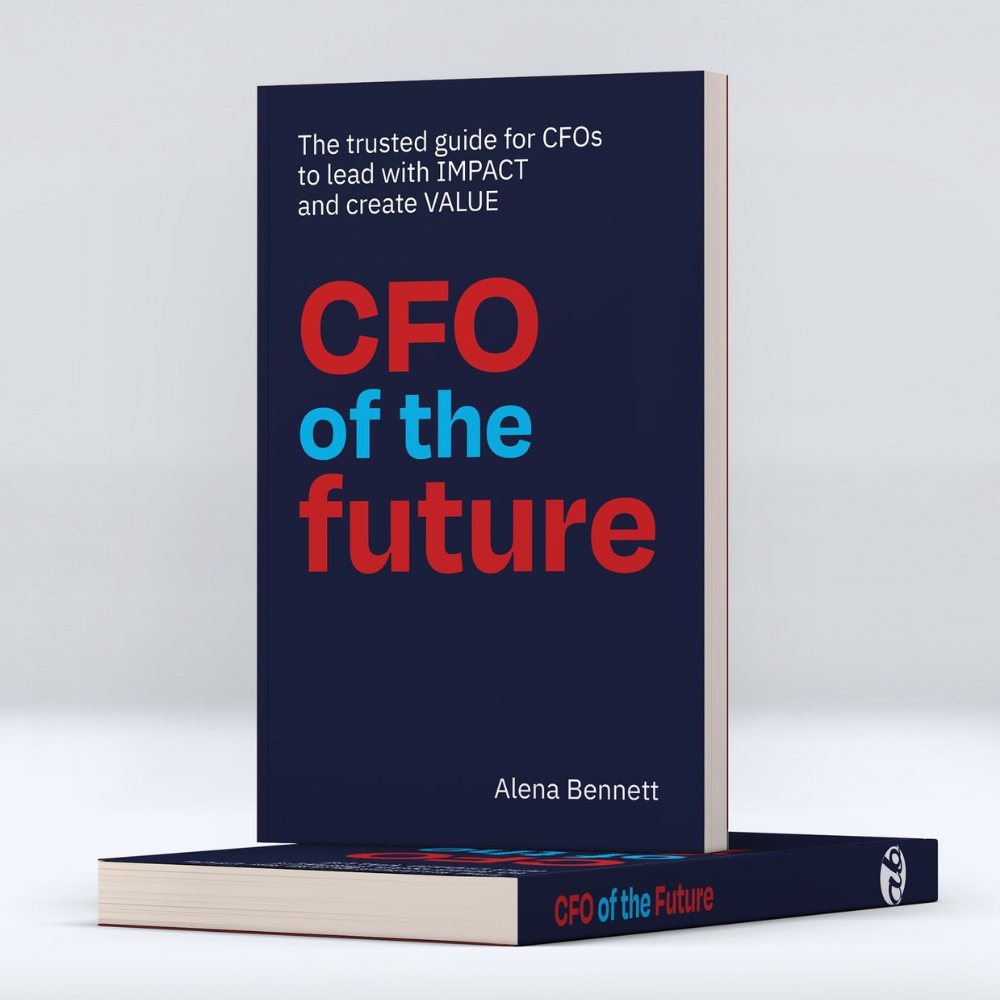
This is the trusted guide for CFOs to lead with IMPACT and create VALUE.

It's time for women in finance to find power in their purpose!