How Playmaker CFOs find the one priority that has the biggest impact before Christmas
Last week you identified and quantified all of the different things that are driving your growth gap. You made this digestible and communicable by plotting those things into a pie graph. (Way simpler than a detailed budget spreadsheet that just shows a lot of red).
On the other side of that process, I expect you felt 2 things at once: clear and a little daunted.
Don't worry, I've got you.
The truth is, you may not be able to close all the gaps by Christmas, and that's okay. What matters is that you now have the information to choose which issue you tackle and cut through first, so that by 1 January, closing the gap is incorporated into how the business runs and you're not distracted by the need to play catch-up.
The trap
Because here's what usually happens. The easy slices of the pie get done. The hard ones get deferred until the 'fresh start' of the new year. It's at that moment leaders start to think 'if only my people were more engaged, more energised, more capable' then it would be easier to achieve the outcome. It's alluring and it feels good to invest in your people.
That allure is the trap.
The question
Before you make or approve the decision to invest in your people (which is always a good decision, by the way, when the ROI is clear), you need to ask yourself an additional question:
What is the structural block to this outcome?
Because there is almost always something structural causing the friction or getting in the way.
Alena, what do you mean by that?
Take last week's example: "our sales team isn't hungry enough". The natural lever is a sales trainer to work on mindset and capability. But ask whether the structure is supporting them:
• Do our incentives reward chasing every dollar?
• Do our systems and cadences show them where the next dollar is?
• Has the value of what we sell, and who it's for, been communicated clearly and reiterated as part of their regular cadence?
If the answer to any of those is 'no', your people aren't the block. The structure is.
Adjust the incentives, show them the market, sell them the value, and their natural response will be 'dang, we'd better get out there!'. If it's not, then you explore the people.
Once you've found the structural change, you can start to prioritise.
Quick wins
Everyone loves a quick win. But a quick win is not about ticking a box and feeling good for it. The ones worth doing free-up capacity for the bigger work that has greater impact.
Which change first
What you're looking for is the structural change that clears the most pie in the least time.
In the CFO Boardroom, we always suggest to our clients that they choose the Play (big goal) that creates the biggest ripple effect from the one outcome. This is exactly the same.
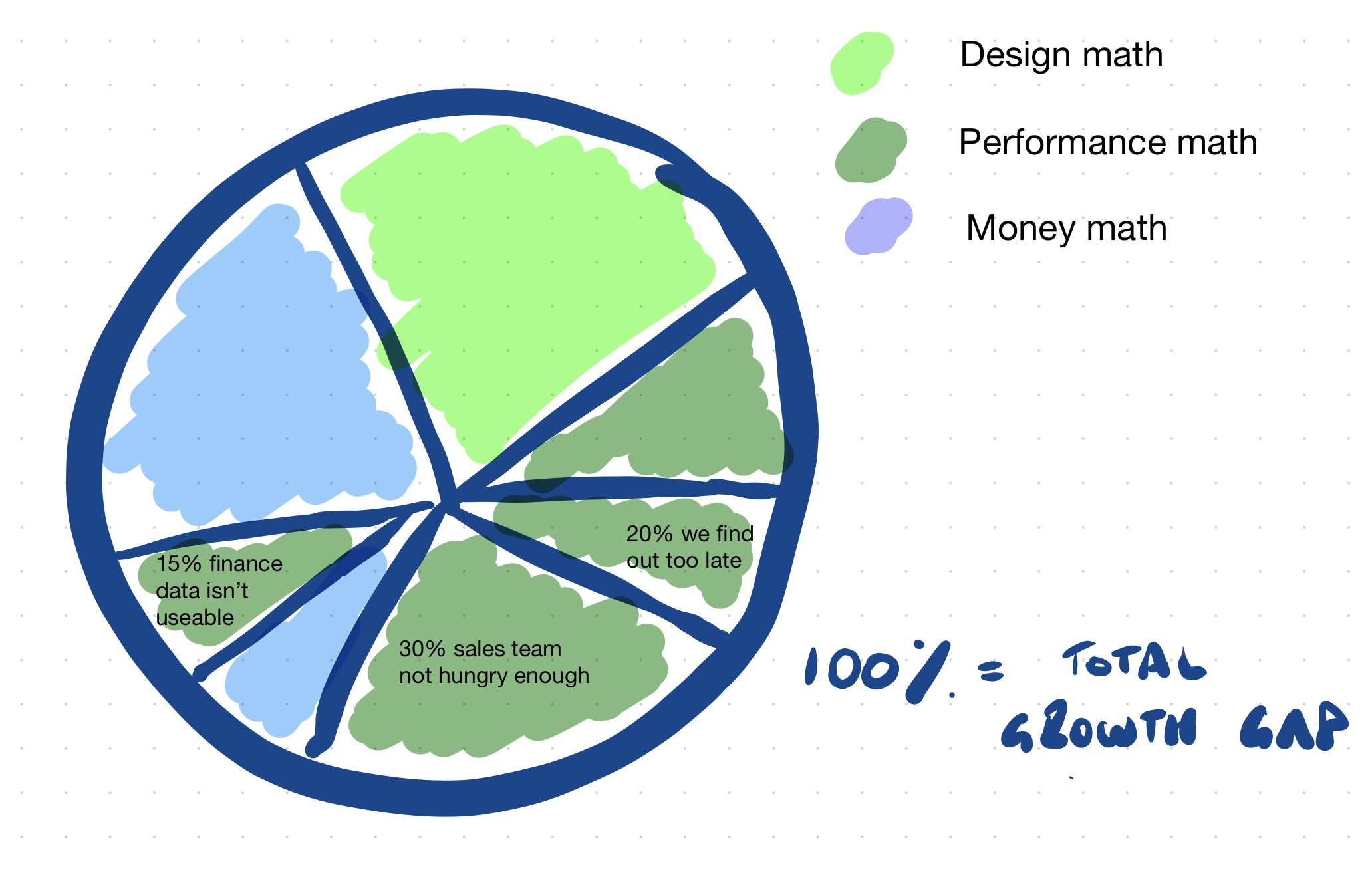
"Your growth gap as a pie: worked example"
Picture the pie from last week. Say 30% of the gap sits with "our sales team isn't hungry enough," 15% with "finance data isn't usable," and 20% with "we find out too late when a deal slips." Three slices, three owners, three fixes. Or so it looks.
Now go back to those sales questions above. Two of the three pointed at the same thing: the weekly cadence. One weekly revenue cadence, run on data the team can actually use, puts the numbers in front of sales, restates the value of what they sell, surfaces slipping deals earlier and gives finance a reason to fix the data. One structural change. Three slices. 65% of the gap. A training program would have aimed at one.
Fixing their incentives may be your second move, but the cadence is the one that clears the most.
When you've found your Play, this is the one you take to your CEO.
So the question I want to leave you with today is this:
Which one structural change would clear the most of your pie?
This week I helped a leader find the one structural change behind three of their slices in 15 minutes. If you think you've found yours, I'm happy to pressure-test it with you.

Author: Alena Bennett

This is the trusted guide for CFOs to lead with IMPACT and create VALUE.

It's time for women in finance to find power in their purpose!